TPO Flat Roofing in Washington, DC
Energy Star white TPO membrane flat roofing for Washington, DC row houses, garages, and additions — heat-welded seams, 20–28 year lifespan, and full drain and flashing replacement.
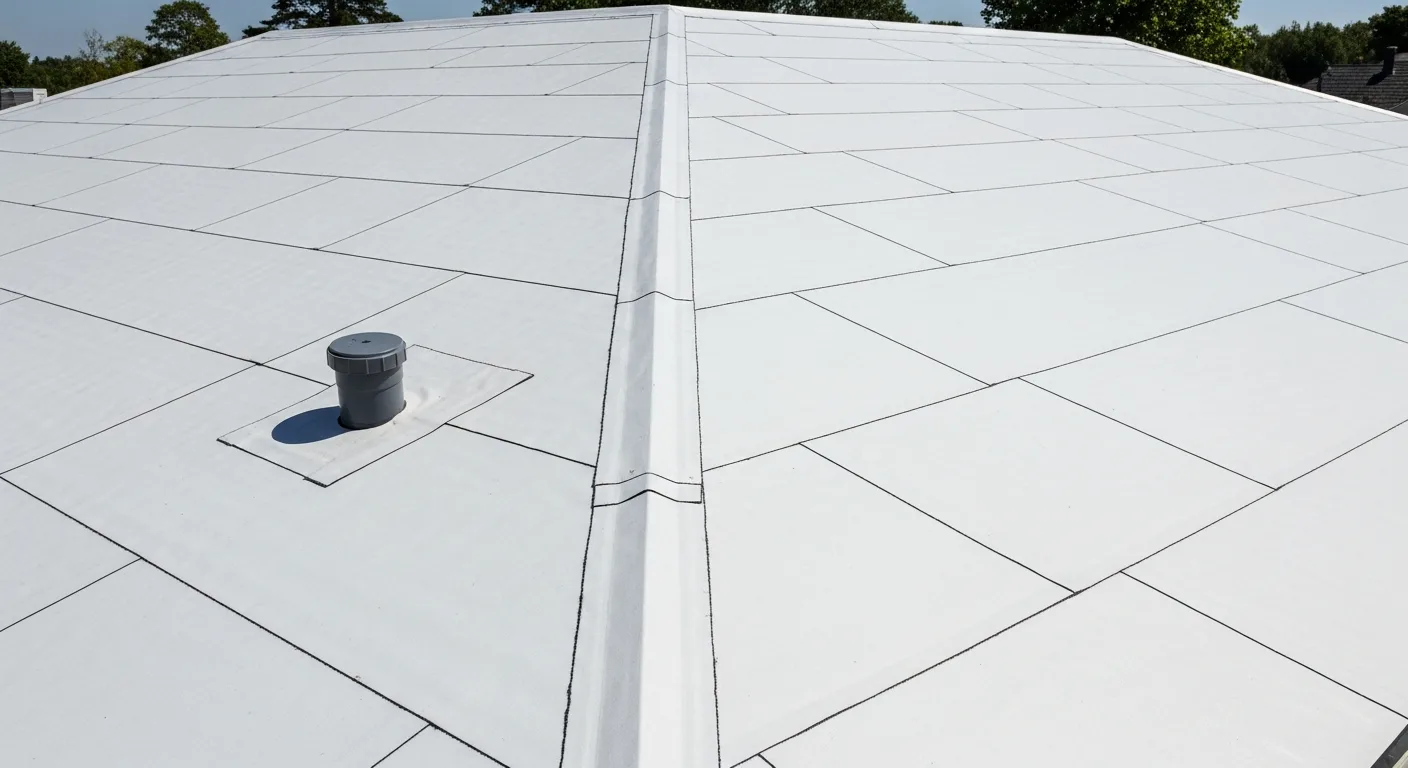
Why TPO for Flat Roofs in Washington, DC?
Thermoplastic Polyolefin (TPO) has become the dominant single-ply flat roofing membrane in the DC metro for new installations. White TPO reflects 70–80% of solar radiation — dramatically reducing summer cooling loads versus dark EPDM or modified bitumen. Heat-welded seams are stronger than the field membrane itself when done correctly, creating a monolithic surface that resists seam failure over the full warranty period.
We install primarily 60-mil and 80-mil GAF EverGuard TPO and Carlisle Sure-Weld TPO — both backed by 20-year manufacturer warranties and capable of 25+ years actual service life in DC-metro UV exposure. Every seam is pull-tested during installation with a hot-air probe and again at the final QC walkthrough.
TPO Flat Roofing for DC Row Houses
Washington DC is the flat-roof capital of the region. The vast majority of DC's residential housing stock consists of attached and semi-detached brick row houses with a combination of a steep-slope front roof and a flat rear section — typically 300–600 sq ft between the front pitched plane and the rear addition or kitchen extension. This flat section is the most commonly replaced roofing element in DC residential construction.
TPO is now the dominant choice for DC flat section replacement upgrades from aging EPDM. White TPO reflects 70–80% of solar radiation — a meaningful energy benefit in DC's urban heat island during peak summer months. Heat-welded seams create a seamless, monolithic membrane that performs well in urban environments where rooftop traffic from HVAC maintenance and neighbor access is common.
Modern upgrade for DC flat sections — white Energy Star membrane; HPRB may review white membranes in some historic districts; heat-welded seams preferred for urban rooftop-traffic environments. Party wall considerations are critical on every DC row house project — the membrane must properly terminate at party-wall caps, and improper party-wall flashing is the #1 source of DC row-house leaks. King's Roofing replaces party-wall cap flashing on every TPO job, not as an optional add-on.
Stairwell Bulkheads: Many DC row houses have rear stairwell bulkheads that require careful flashing integration with the flat membrane. We custom-fabricate bulkhead flashings for each project.
DCRA Permits & HPRB Historic Districts: All DC roofing work requires a DCRA building permit. For properties in historic districts (Georgetown, Capitol Hill, Shaw, Logan Circle, etc.), HPRB may review visible material or color changes. White TPO may require HPRB clearance in some historic districts — King's manages the full process. Black EPDM is typically approved without review in historic contexts.
What's Included in a King's Roofing TPO Installation
- Full tear-off of existing membrane down to structural deck — no installations over existing material
- Deck inspection and repair — soft spots replaced with new plywood before membrane installation
- Tapered insulation upgrade (where needed) — eliminates chronic ponding that shortens membrane life
- 60-mil or 80-mil TPO membrane — heat-welded seams, mechanically fastened or fully adhered per wind-zone calculation
- Drain replacement or cleaning — we inspect all internal drains and scuppers as part of every job
- Penetration flashings — HVAC curbs, pipe boots, and conduit feet custom-flashed per membrane manufacturer requirements
- Parapet wall and edge terminations — counter-flashing and metal termination bars at all roof edges
- 20-year manufacturer warranty registration — filed in your name with the membrane manufacturer
Internal Links for Your Washington, DC Roofing Project
- Roofing in Washington, DC — full roofing services overview for Washington
- Flat & Low-Slope Roofing — all membrane options for Washington
- Free Phone Consultation — schedule a no-obligation estimate
- All Roofing Services — complete service menu for the DC metro
DC Contractor Licensing & Compliance
King's Roofing holds a current DC contractor license issued by the DC Department of Consumer and Regulatory Affairs (DCRA) Business License Division — required for all roofing and home improvement work in Washington, DC. Our DC contractor license number is displayed on every Washington DC proposal and contract. You can verify our license status through DCRA's online contractor verification portal before signing any agreement.
DC roofing law requires that any contractor performing repair or replacement work on a DC property hold a valid DC business license AND a DC home improvement contractor registration. King's Roofing maintains both, along with $2 million general liability insurance and workers' compensation coverage for all crew members working on DC properties.
When hiring any roofing contractor in Washington, DC, always request: (1) DC contractor license number, (2) proof of current general liability insurance, (3) workers' compensation certificate. King's Roofing provides all three on request before project commencement.
Common TPO Flat Roof Failures in Washington, DC
Understanding the most common failure modes helps you recognize problems early — before minor issues become major water damage events. The four most common TPO failures on Washington, DC flat roofs:
- Seam separation: Heat-welded seams can separate at poorly-welded T-joints or at penetration flashings under sustained temperature cycling. Early signs: visible gap at the seam line, lifting membrane edges, or water staining on interior ceilings below the seam path. Remedied by re-welding or patch installation while the surrounding membrane is intact.
- Drain bowl ponding: Compressed insulation around drain bowls causes the membrane surface to pond long after rain stops. Standing water beyond 48 hours shortens TPO life significantly. Fix: tapered insulation crickets around drain sumps to restore positive drainage slope.
- HVAC curb flashing failure: Rooftop HVAC units move with temperature and vibration. The flashing boot at the base of each curb can separate from the membrane over time. These are the #1 active-leak source on commercial TPO roofs in Washington.
- Parapet and edge terminations: Metal termination bar and counter-flashing at parapet walls eventually corrodes or separates in DC-metro freeze-thaw cycles. Failed terminations allow water to track behind the membrane at the roof perimeter.
King's Roofing performs a structured inspection protocol on every Washington, DC flat roof: seam probe test, drain flow check, penetration inspection, and perimeter termination review. We document every finding with photos before recommending repair or replacement.
TPO Maintenance Schedule for Washington, DC Properties
Maximizing your TPO roof's lifespan requires routine maintenance — not just reactive repair. King's Roofing recommends the following annual maintenance program for Washington, DC TPO roofs:
- Spring inspection (April–May): Post-winter check for any freeze-thaw seam movement, ice-dam related flashing damage, and debris from winter storms accumulated at drains.
- Fall inspection (October–November): Pre-winter drain clearing and inspection before fall leaf accumulation blocks internal drains. Check and re-secure any lifted termination bars from summer heat cycling.
- Post-storm inspection: After any hail event or wind event exceeding 50 mph, a membrane inspection verifies that no seams have lifted or penetration flashings have separated.
- Drain maintenance: Internal drains should be cleared of debris at minimum twice per year. Blocked drains are the single most preventable cause of premature TPO membrane failure.
King's Roofing offers annual maintenance programs for Washington, DC property owners that include scheduled inspections, minor seam repairs, drain clearing, and priority scheduling for emergency repairs. Contact us to ask about maintenance plan options for your TPO roof.
Frequently Asked Questions — TPO Flat Roofing in Washington, DC
What does a TPO flat roof replacement cost in Washington, DC?
60-mil TPO flat roof replacement in Washington, DC runs approximately $7,500–$14,000 installed for typical residential flat sections (500–1,200 sq ft), including full tear-off, tapered insulation upgrade where needed, drain inspection, and a 20-year manufacturer warranty. Final pricing requires on-site inspection and measurement.
How long does a TPO flat roof last in Washington, DC's climate?
Properly installed 60-mil TPO in the DC metro typically lasts 22–28 years with annual inspections. The key longevity factors are seam quality (heat-welded > tape-bonded), drain maintenance (preventing ponding), and penetration flashing integrity. We recommend annual inspection and drain clearing for all Washington flat roofs.
Does white TPO require HPRB approval in a DC historic district?
It depends on the specific historic district and whether the roof is visible from a public way. In some DC historic districts, the HPO or HPRB requires review of membrane color changes from dark EPDM to white TPO. King's Roofing prepares the HPRB submittal when required and has a track record of successful clearances. For non-historic-district properties, DCRA permit only (no HPRB review).
How long does DCRA take to permit a TPO flat roof replacement in DC?
DCRA residential building permits for flat roof replacement typically take 4–8 weeks. We submit electronically through DC Access eServices and follow up actively to keep the review moving. HPRB historic review, when required, adds 4–8 additional weeks. King's Roofing accounts for these timelines in project scheduling.
How does TPO improve energy efficiency for a DC row house?
White TPO reflects 70–80% of solar radiation versus 5–10% for black EPDM. On a DC row house flat section (typically 400–800 sq ft), TPO upgrade reduces summer cooling loads meaningfully — DC homeowners typically see 15–25% summer cooling cost reduction after switching to reflective TPO. DC's urban heat island makes this benefit particularly significant during June–September peak heat.
Ready to get a flat roof or metal roof estimate for your Washington, DC property? Call (703) 712-1506 or schedule a free phone consultation — we respond within one business day and can often inspect within the same week.